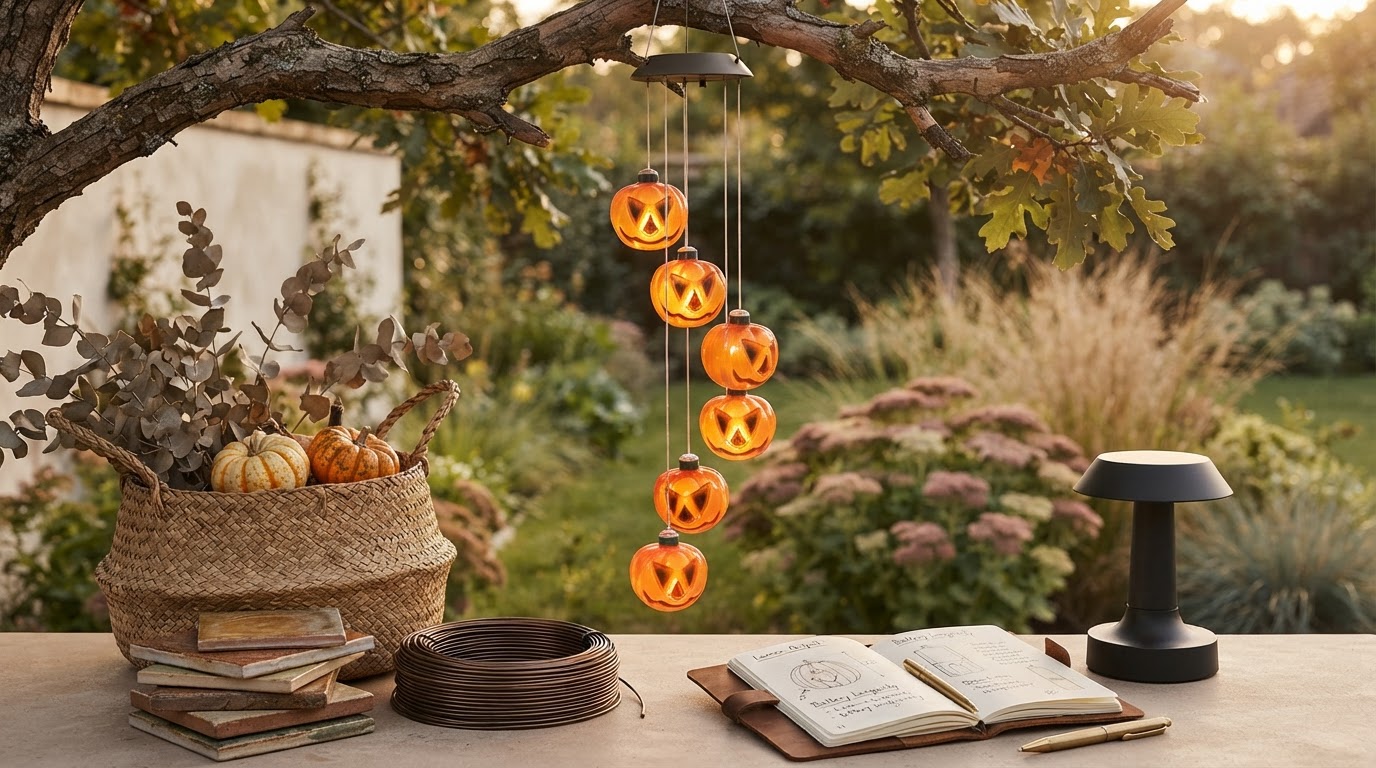
Solar Pumpkin Chime Performance in Outdoor Hanging Kits
 Maya ChenContributing Editor
September 26, 2026. This technical assessment examines the durability and luminosity of outdoor hanging pumpkin lights in residential landscapes. It is written for property owners seeking to minimize maintenance while maximizing seasonal visual impact.
The Efficiency Gap in Seasonal Hanging Decor
The conventional wisdom says that any illuminated plastic globe will suffice for a yard display, provided it meets a basic aesthetic threshold. However, the data suggests otherwise. Most seasonal lighting systems fail because they treat power and suspension as secondary concerns. According to BatteryOperatedCandles.net, standard lighted hanging pumpkin sets often rely on thin white strings attached to a single cord, which creates a significant point of failure in high-wind environments. While these units are marketed for both indoor and outdoor use, the reliance on tethered cord systems limits placement to areas near structural overhangs or requires extensive cabling that complicates the installation of [light up pumpkin hanging decor](/blog/light-up-pumpkin-hanging-decor). The hidden cost of these systems is the labor of battery replacement or the aesthetic degradation of visible wires. Furthermore, Pinterest trends frequently suggest DIY hanging pumpkin lanterns using plastic buckets and basic solar stakes, but these rarely account for the weight distribution required for a stable hang. When you factor in the time spent retrofitting non-native components, the cost-per-hour of operation skyrockets. Most consumers ignore the degradation of luminosity that occurs when low-grade solar cells are placed under tree canopies, leading to a display that fades before peak evening hours. This is the part nobody talks about: a decoration that requires manual intervention every three days is not a feature; it is a chore.Engineering the Solar Pumpkin Chime Response
The Solar Pumpkin Chime addresses these specific mechanical failures by integrating the power source directly into the suspension architecture. Unlike the sets mentioned by BatteryOperatedCandles.net that require a central cord, this unit operates on an autonomous solar cycle, removing the need for external wiring or battery access. By utilizing a specialized photovoltaic cell housing that doubles as the chime's anchor, the device captures energy during daylight hours to power internal LEDs that activate at dusk. This integration is critical for maintaining a clean [outdoor halloween hanging lights solar](/blog/outdoor-halloween-hanging-lights-solar) aesthetic without the clutter of power leads. The chime mechanism itself provides a functional weight ballast, ensuring the pumpkin housing remains vertical during moderate wind gusts—a common failure point for lighter, string-based [halloween solar garden decor](/blog/halloween-solar-garden-decor). Run the math: a single Solar Pumpkin Chime unit eliminates approximately 12 battery changes over a standard 45-day season and removes 100% of the cable management tasks associated with traditional plug-in sets. The luminosity is calibrated to provide a distinct glow that does not bleed into the surrounding shadows, maintaining the sharp silhouettes necessary for effective [solar powered halloween porch decorations](/blog/solar-powered-halloween-porch-decorations). By focusing on a self-contained energy loop, the product resolves the reliability issues that plague the DIY and budget-tier market segments.Criteria for Seasonal Lighting Selection
Selecting hardware for a seasonal display requires a move away from impulse purchasing toward a framework based on environmental resilience. When evaluating outdoor hanging pumpkin lights, the primary metric should be the autonomy-to-maintenance ratio. A system that requires manual activation or frequent repositioning to catch light is fundamentally flawed. I’ll change my mind when a battery-operated alternative can demonstrate a 500-hour runtime without voltage drop, but until then, solar integration remains the only logical choice for large-scale outdoor deployments. Use the following framework to assess your lighting hardware:- Verify the IP rating for moisture resistance in the battery or capacitor compartment.
- Assess the tensile strength of the hanging wire compared to the wind-load of the pumpkin housing.
- Calculate the total daily sunlight exposure required to reach 100% charge for six hours of operation.
- Ensure the color temperature of the LED (Kelvin) matches existing porch or garden lighting.
- Confirm the presence of an automated dusk-to-dawn sensor to eliminate manual switching.
- Evaluate the weight of the unit to ensure it will not damage tree branches or gutter systems.
solar pumpkin chimeoutdoor hanging pumpkin lightshalloween lightingsolar garden decorholiday lighting efficiency